What's changing?
Every driver who transports children under age 18 in a vehicle will be required to have them restrained in a child safety seat or with a seat belt.
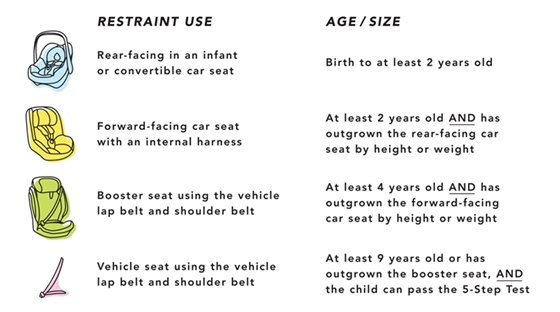
The updated law gives more guidance to parents and caregivers as they strive to keep kids safe. Prior to the changes, state law required car seats to be used according to manufacturer's instructions on height and weight. Now, instead of just relying on the child's size, the law specifies ages for rear- and forward-facing car seats, booster seats and seat belts (subject to weight and height depending on the child seat manufacturer). In addition, the booster seat requirement has been increased from 8 to 9 years old. The age guidelines include:
Birth to at least 2 years old:
- Rear-facing in an infant or convertible child safety seat.
At least 2 years old AND has outgrown the rear-facing seat with internal harness by height or weight:
- Forward-facing with an internal harness.
4 years old AND has outgrown the forward-facing seat with internal harness by height or weight:
- Ride restrained in a belt-positioning booster seat using the lap belt and shoulder belt.
9 years old or has outgrown the booster seat AND the child can pass the five-step test that demonstrates how the seat belt fits correctly:
- Ride restrained with a lap belt and shoulder belt secured correctly on the vehicle seat.
Additionally, children under 13 years old must sit in the back seat if possible.
New law based on best practice
The new law is based on best practice and mirrors the American Academy of Pediatrics child seat recommendations. It keeps children from prematurely graduating to the next level of restraint.
If a child falls into more than one category, then the child must be placed in the safer restraint for them. For example, a child who is 2.5 years old and weighs 35 pounds but has a car seat with a rear-facing limit of 40 pounds must stay rear-facing even though they are over 2 years old. It's very important for parents and caregivers to always read their car seat and vehicle owners' manuals for proper installation.
“We all want our children to be as safe as possible while we're driving, and that means making sure they are in the proper child restraint," said Minnesota Department of Public Safety Office of Traffic Safety (OTS) Director Mike Hanson. “The new law lays out best practices and will help parents make the best decision to protect their child."
Why it's important
Crashes are a leading cause of injury and death among children. Proper car seat use helps protect and minimize injuries to our youngest passengers.
In Minnesota crashes from 2019 to 2023, preliminary figures show:
- Of the 12,827 children ages 0-7 properly restrained, 89 percent were not injured. Another 10 percent sustained only minor injuries.
- 20 children ages 0-7 were killed in motor vehicles. Of those, only 10 were known to be properly secured.
- Of the 81 children (ages 0-7) seriously injured in motor vehicles, only 44 percent were known to be properly secured.
Resources



 Share on Facebook
 Share on Twitter
 Share via Email
