Kevin Raney Represents Owatonna at Minnesota Transportation Conference
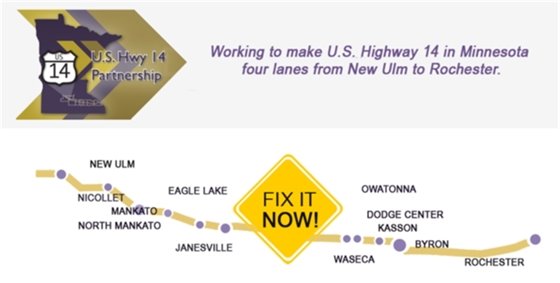
Owatonna’s role in improving the safety and efficiency of Highway 14 was highlighted at the Minnesota Transportation Conference May 30. Kevin Raney, City Council Member, was asked to speak to attendees about how a coalition formed by multiple cities, including Owatonna, successfully secured legislative support for the construction of this vital east/west corridor that serves Owatonna and the broader region. Raney has represented Owatonna on the Highway 14 Coalition since 2012 and began serving as its president since 2022. The highlights of his presentation are summarized below.
How and why the Highway 14 Coalition was formed
In the early 1990s, mayors and city council members joined county commissioners, chambers of commerce, private businesses and other stakeholders of the communities along Highway 14 to form a coalition with the goal of creating a four-lane highway connecting New Ulm and Rochester. Since 1950s, the need to make Highway 14 four lanes has become increasingly more important as the need to move people and goods on this east/west corridor has grown.
Project goals
The goals of the project were to positively impact the safety, economy and quality of life in Southern Minnesota. Along with the need for moving traffic more efficiently on this 110-mile east/west route, even more important was the need to address safety concerns. Traffic accidents, some involving deaths, had become an issue that clearly needed to be addressed. Building a safe, efficient, four-lane divided highway was the only solution to reach these goals.
How the partnership functioned
Elected officials from cities along the route remained committed despite election turnover. As segments of the highway were completed, most communities remained active to continue pursuing the project to full completion. The overall mentality wasn’t ‘Our part is done’, but rather it was ‘We’re in this until it’s done. For the 30-plus years since the coalition was formed, its members have steadily attended meetings twice annually – this included MnDOT representatives, local legislators, the MnDOT Commissioner and community representatives from along the corridor.
Challenges
As with any major highway project, the primary challenge to completing the project was lack of funding. Initially, it seemed daunting to connect the bookends of this corridor – the four-lane stretch in Mankato on the west end of the project to the four-lane stretch from Byron to Rochester on the east end of the project. Due to economic downturns over the years, the project was put on hold by state planners multiple times. For a time, MnDOT’s practice was to address existing roadways that needed repairs rather than focusing on the areas where new highways, like 14, were needed. One argument against the project was that traffic numbers were not significant enough to warrant funding, however, the volume of fatalities and the need to move commerce more efficiently and safely were recognized as being important issues that needed to be resolved. Another significant challenge was purchasing the rights of way needed for the project – without the project being classified as ‘shovel ready’, state and federal funds were out of reach. In addition, the Environmental Impact Statements that were originally completed became outdated before funding was secured.
Why it worked
The project being completed was largely due to broad cooperation supporting it. MnDOT Districts Six and Seven worked together rather than competing for funding even though it meant some areas had to wait patiently for their segments to be funded and completed. Together, legislative support was secured by attending and speaking at many state transportation committee hearings. Legislators from around the state became familiar with the coalition and this project. Due to multiple accidents, MnDOT responded to develop a plan to address safety concerns on specific portions of highway 14 – for example, the Eagle Lake intersection was improved by adding J-turns. The coalition succeeded in assisting the state legislature and MnDOT in creating the Corridors of Commerce program which provided a new funding source for greater Minnesota highway projects that support business transit. The Coalition retained Flaherty and Hood - a lobbyist group that is well respected by the state legislature and able to help tell the compelling story about the need to support the project. Member communities worked together as a group with a strong voice at the capital. Even though the coalition’s requests were denied multiple times over the decades, the group persisted in creating awareness about the need for this project to vastly improve safety, boost local economies and contribute to a higher quality of life in southern Minnesota.
Highway 14’s future needs
The corridor still needs the interchanges in Byron and east of Mankato to be addressed. MnDOT District 6 is currently engaged with its partners in Olmsted and Dodge Counties, as well as municipalities along that end of the corridor, to study possible improvements that can be made to address the safety issues there. At some point, there may be a need to form a new Highway 14 coalition to address issues west of New Ulm. For additional information about the U.S. Highway 14 Partnership, visit ushighway14.com.















 Share on Facebook
 Share on Twitter
 Share via Email
